
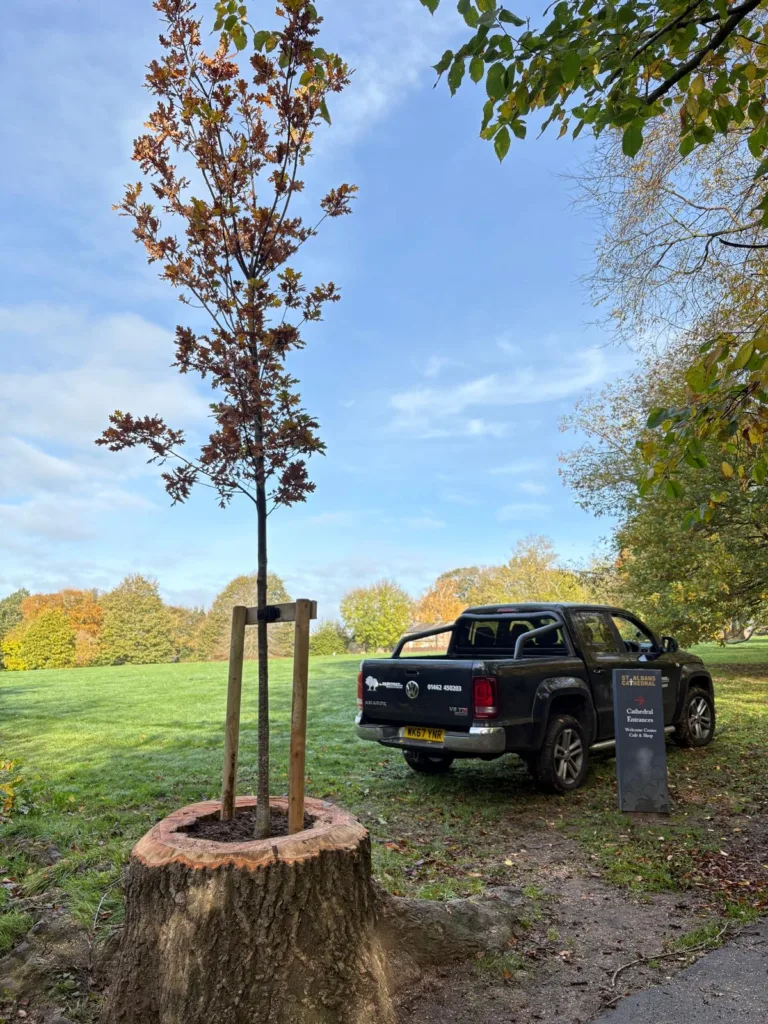
A Creative Twist on Tree Planting at St Albans Cathedral
In a creative twist on tree planting, we recently planted a new oak tree within the hollowed stump of a dead ash tree in the grounds of St Albans Cathedral. Having supported the cathedral with their tree management for many years, we were delighted to be involved in such a thoughtful and unique planting project.
To prepare the space, we trimmed and shaped the old ash stump, chamfering the edges for a clean finish and sealing the base to prevent future root escape. This innovative approach transforms the stump into a natural planter, offering the young oak protection from animals that might otherwise nibble at a new sapling—without the need for artificial guards or cages. As the ash stump gradually decomposes, it will enrich the soil, feeding the oak with valuable nutrients and creating a hopeful, cyclical future.
Inspired by Nature: The Power of Nurse Logs
In forests, fallen trees play a crucial role in helping new plants grow. These “nurse logs” act as natural nurseries for seedlings, providing a sheltered microhabitat that supports biodiversity and resilience. As the wood breaks down, it releases nutrients, holds moisture, moderates temperature changes and offers structural support. Moss, fungi and leaf litter build up around the decaying trunk, creating conditions that help young trees establish strong, stable roots.
We brought this natural principle into the cathedral grounds, adapting the idea of a nurse log to an urban setting by using the hollow ash stump as an eco-friendly planting solution.
Why an Oak Inside an Ash Stump?
It’s a reasonable question: why not plant another ash? The answer lies in ecology and plant health. Soil pathogens often specialise in certain species. A young ash growing in an ash stump could be exposed to harmful diseases—particularly considering ash dieback and other pathogens that linger in the soil.
By choosing an oak sapling instead, we avoid ash-specific pathogens and give the young tree access to the nutrients and structure provided by the slowly decaying stump. This approach also mimics natural woodland regeneration, where a mix of species grows together, reducing competition and improving biodiversity.
Not all trees are suitable for this method, but we’re always happy to advise on the right species and approach for your landscape.
A Sustainable Idea for Urban and Garden Spaces
Using a decaying stump as a planter isn’t just environmentally friendly—it’s practical too. It reduces waste, avoids the need for manufactured materials, and reuses natural resources that would otherwise be removed. The stump also helps retain moisture, protect roots and slowly release nutrients as it breaks down.
As the oak grows stronger, the ash stump will continue to decompose, feeding the young tree and enriching the surrounding soil. It’s a beautiful example of circular ecology brought into a managed landscape.
Final Thoughts
Dead trees aren’t just lifeless—they’re life-givers. By using nurse log principles, we can help seedlings grow healthier, stronger and more resilient while supporting biodiversity and sustainability. The new oak in the ash stump at St Albans Cathedral is a small but powerful reminder that even in decay, nature is full of opportunities to nurture new life.
If you’d like advice on sustainable planting, ecological tree care or bespoke tree management call us on 01462 450203.